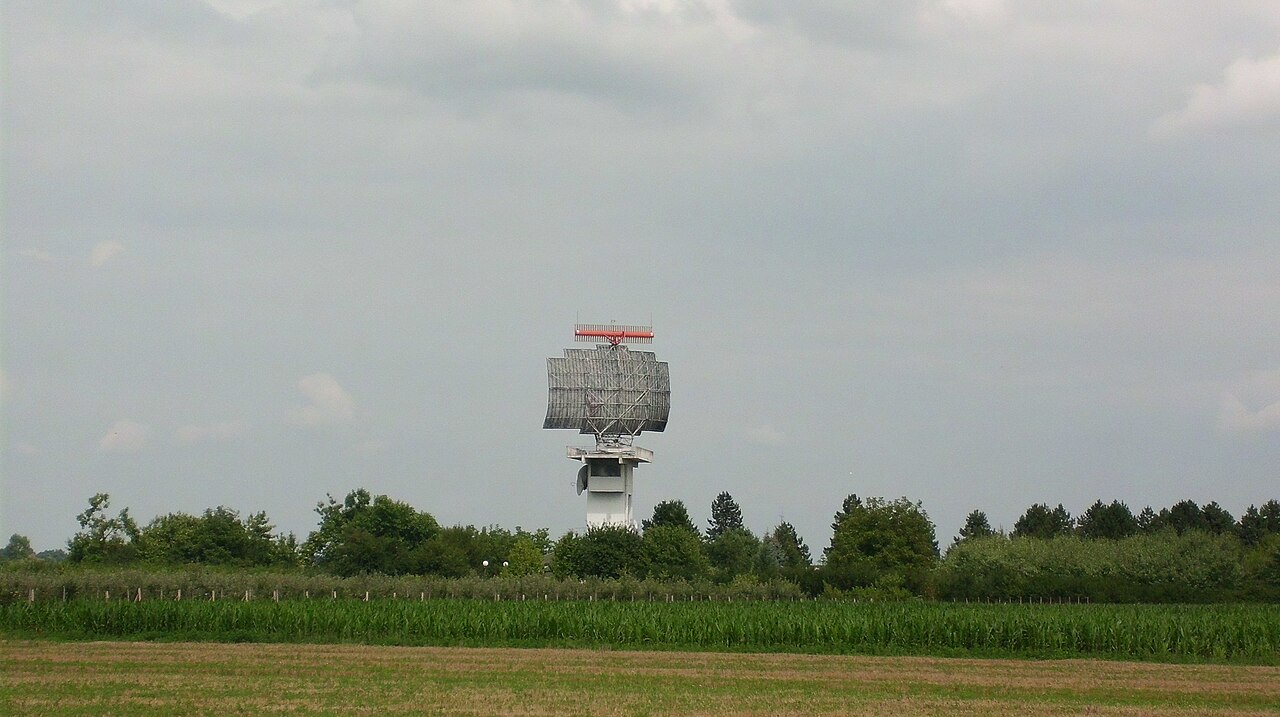
ASR-9 Airport Surveillance Radar
Aviation & Air-Traffic-Control Antennas Microwave Directional SHF Aviation Radar
The rotating S-band primary radar that paints aircraft in the airspace around an airport.
- Band
- S-band (2.7-2.9 GHz)
- Gain
- ~34 dBi
- Polarization
- Circular (selectable) for rain rejection
Photos
Radiation / wave patterns
New to these diagrams? How to read a radiation pattern →
How & why it works
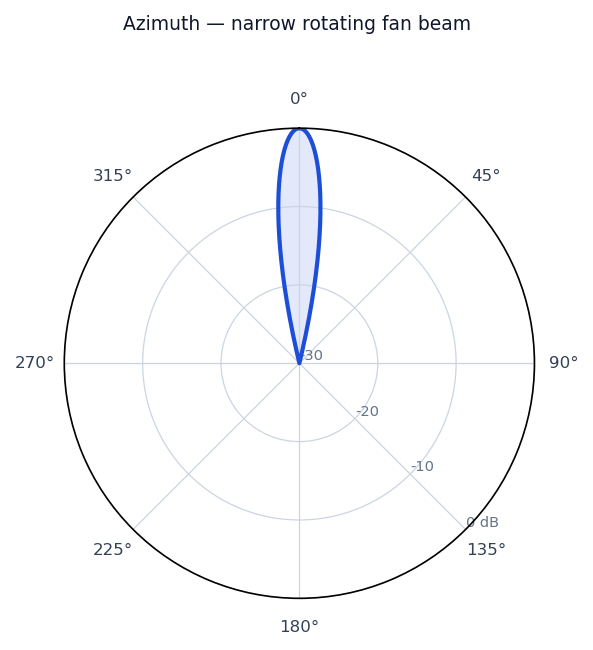
The ASR-9 is a terminal-area primary surveillance radar: a large rotating reflector antenna shaped to produce a 'cosecant-squared' fan beam—narrow in azimuth (about 1.4 degrees) for good bearing resolution, but deliberately shaped in elevation so aircraft at all heights out to ~60 nautical miles return similar signal strength. It transmits high-power S-band pulses (2.7-2.9 GHz) from a klystron and listens for the faint skin echoes reflected by aircraft, using circular polarization so rain (which reflects the opposite sense) can be rejected while aircraft echoes survive. The antenna turns roughly 12-13 times a minute, so every aircraft is revisited every few seconds.
Real-world uses
Primary surveillance of the terminal airspace at busy airports, feeding controllers' radar displays.