Bowtie Antenna
Wire Antennas UHF Wideband 🔧 Buildable at home
A dipole with triangular flared elements for wideband, often UHF, use.
- Band
- UHF (also VHF)
- Gain
- ~3-6 dBi (single), more in arrays
- Polarization
- Linear
Photos
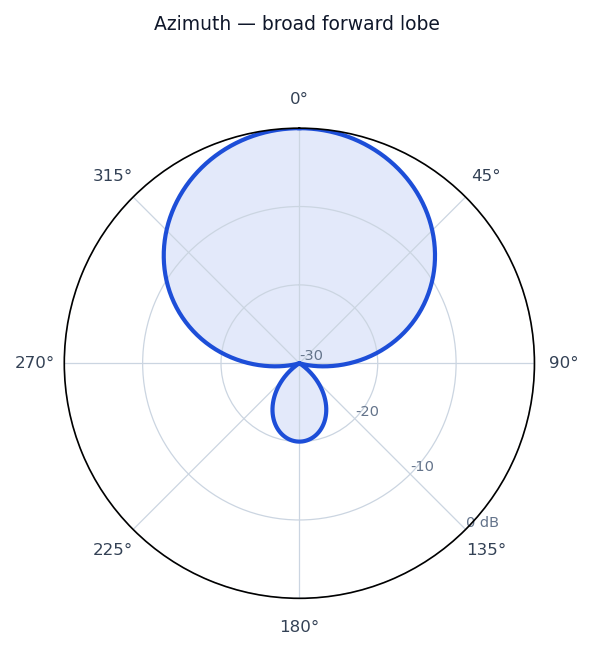
Radiation / wave patterns
New to these diagrams? How to read a radiation pattern →
How & why it works
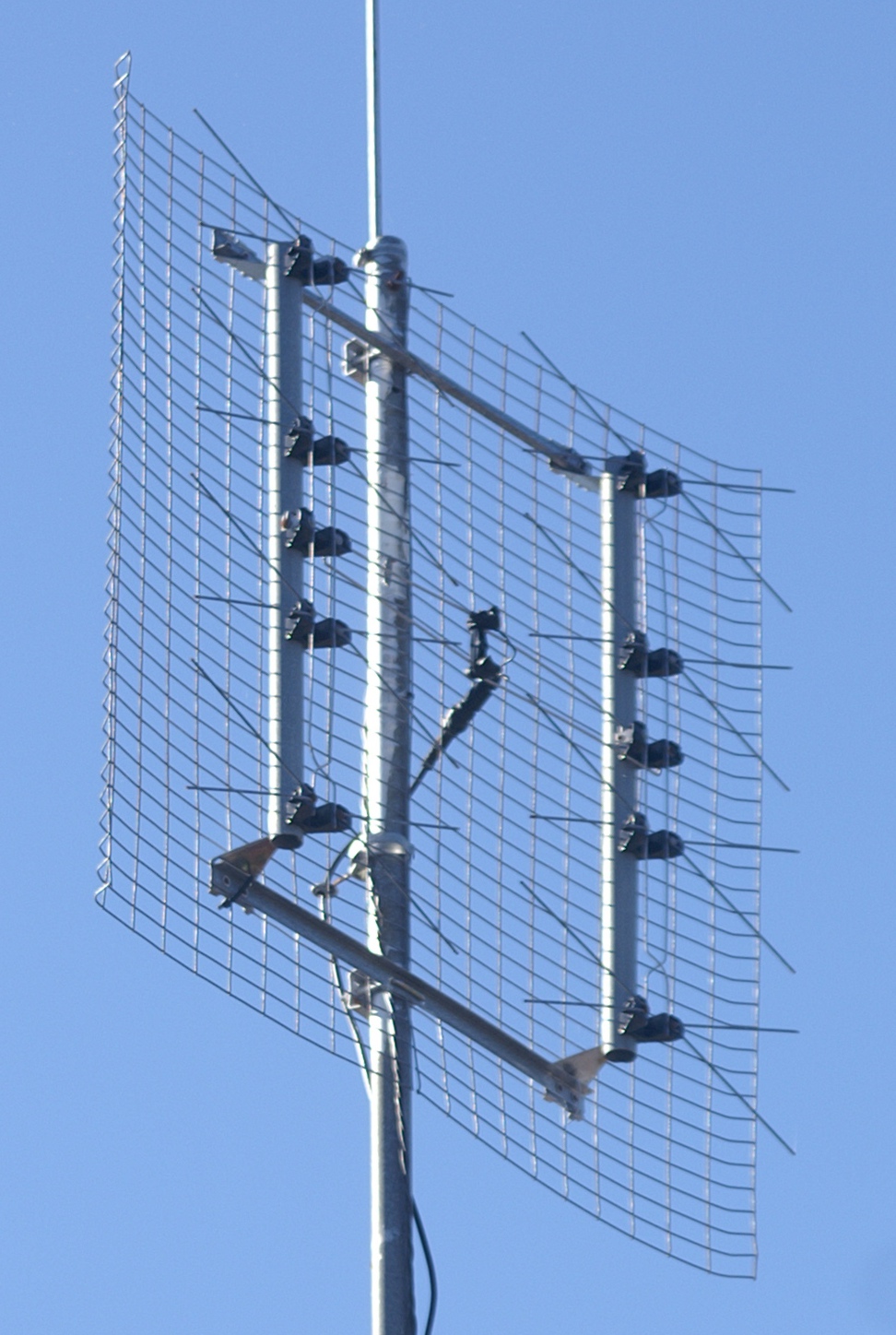
A bowtie replaces a dipole's thin rods with two triangular (or mesh) 'fans' meeting at the feedpoint. Fattening the elements this way dramatically lowers their Q, so the antenna stays well matched across a wide band rather than being sharply resonant. Backed by a reflector screen and stacked into arrays, bowties make compact, broadband, high-gain panels.
Real-world uses
UHF television reception, wideband test antennas, and broadband panel arrays.
Make one at home
A practical starting point — always trim and check SWR for your exact frequency.
See the finished antenna pictured above ↑.
A bowtie (and the multi-bay version) is an easy, broadband UHF TV antenna you can build from coat-hanger wire.
You’ll need
- Stiff wire/rod for the ‘V’ elements
- A wooden or plastic boom; a wire-mesh or screen reflector for gain
- A 300 Ω → 75 Ω balun (matching transformer)
Build (single bay)
- Make two ~21–22 cm wire ‘V’s (whiskers), each arm ~18 cm, opening ~90°.
- Mount them tip-to-tip with a small gap at the feedpoint.
- Connect the balun across the gap; add a reflector screen ~8–10 cm behind for more forward gain.
Notes
Stacking four bays (‘4-bay bowtie’) in front of a common reflector gives a high-gain UHF antenna. Dimensions are broad — UHF TV is wideband, so precision isn’t critical.
Safety
- Keep antennas well clear of power lines — never put one where it could fall onto or contact mains wiring.
- Don’t transmit while anyone is close to the antenna; mind RF-exposure limits and your local licensing rules.
- Ground masts and use coax surge protection where appropriate.
- Cutting/soldering: eye protection and a ventilated space.