Cubical Quad
Directional Antennas HF Directional 🔧 Buildable at home
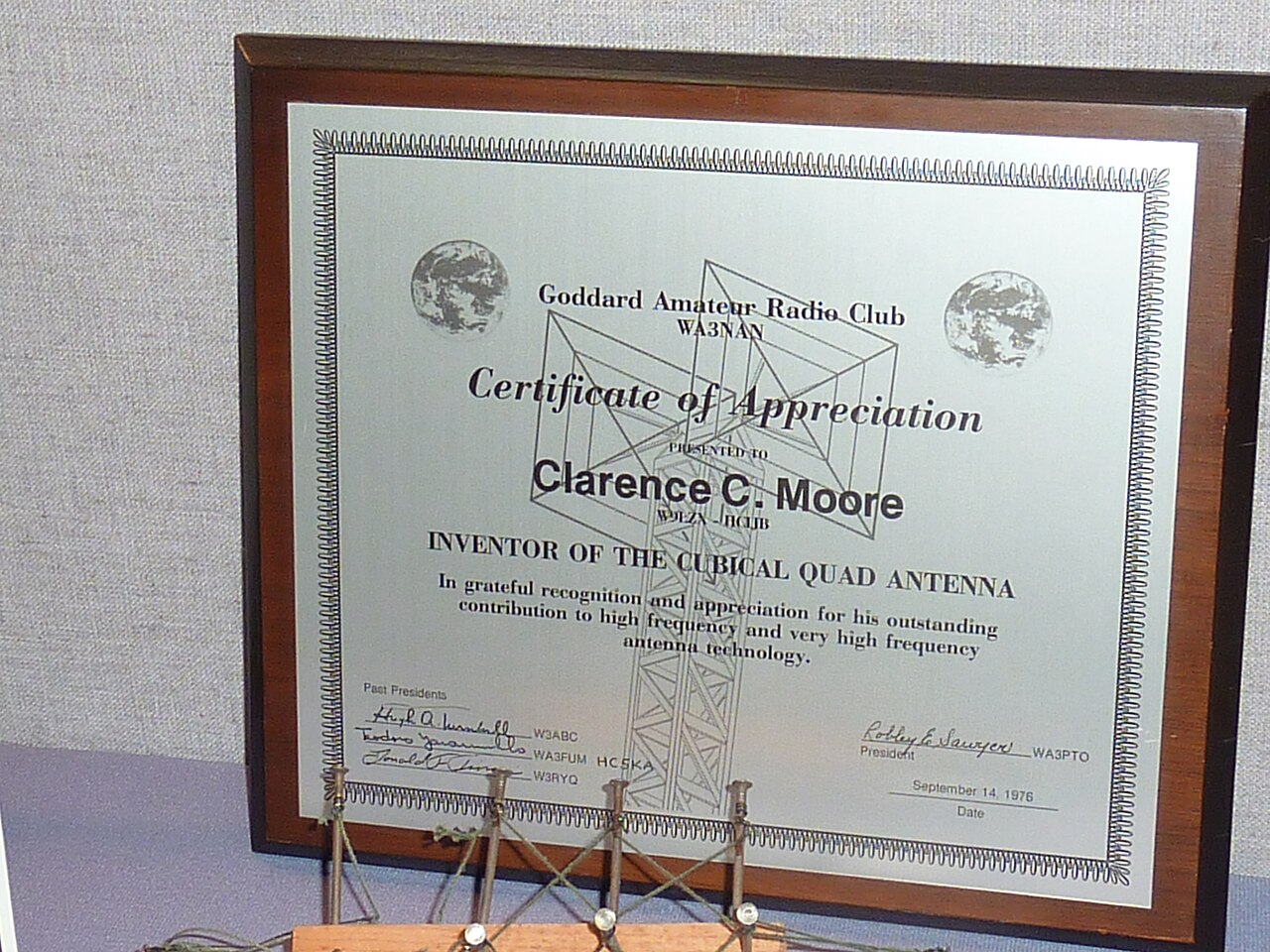
A beam built from full-wave loops instead of straight elements.
- Band
- HF/VHF
- Gain
- ~7-10 dBi (2-3 elements)
- Polarization
- Horizontal or vertical (feed dependent)
Photos
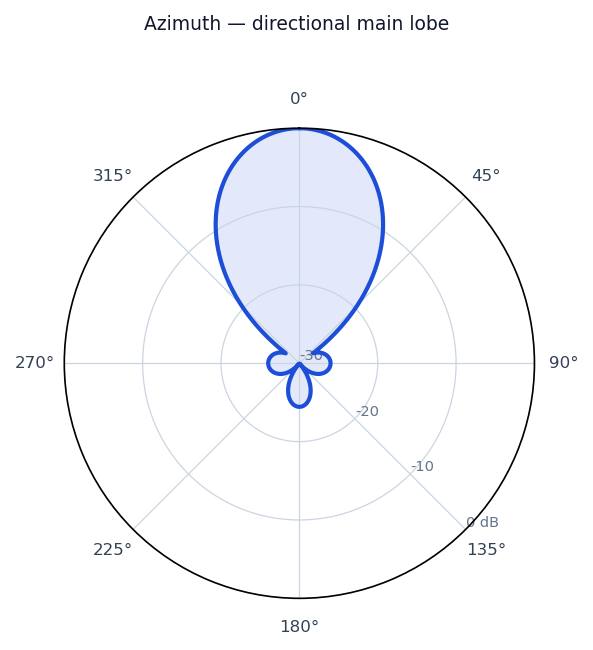
Radiation / wave patterns
New to these diagrams? How to read a radiation pattern →
How & why it works
A cubical quad is the loop equivalent of a Yagi: a driven full-wave loop is paired with a reflector loop (and optional director loops) on a boom. The parasitic loops re-radiate with phasing that reinforces the signal forward and cancels it backward, producing directional gain. Compared with a Yagi of similar size, the quad often shows slightly more gain per boom length and a lower radiation angle, at the cost of a bulkier, three-dimensional structure.
Real-world uses
HF DX beams, contesting, and VHF point-to-point links.
Make one at home
A practical starting point — always trim and check SWR for your exact frequency.
See the finished antenna pictured above ↑.
A 2-element cubical quad is a loop beam — more involved because of the spreaders, but a great performer.
You’ll need
- A spreader frame (fibreglass or wood ‘X’ arms) for each loop
- Wire for the loops; a boom to hold the two loops
Dimensions (per loop, by band)
- Driven loop ≈ 306 ÷ f(MHz) metres of wire (one wavelength)
- Reflector loop ~3% longer
- Loop-to-loop spacing ~0.15–0.2 λ along the boom.
Build & tune
- String each wire loop around its spreader ‘X’ to form a diamond.
- Feed the driven loop at the bottom corner (horizontal) via a 1:1 choke; the reflector loop is a closed loop (or has a tuning stub).
- Trim the driven loop for lowest SWR; the slightly larger reflector sets the front-to-back.
Safety
- Keep antennas well clear of power lines — never put one where it could fall onto or contact mains wiring.
- Don’t transmit while anyone is close to the antenna; mind RF-exposure limits and your local licensing rules.
- Ground masts and use coax surge protection where appropriate.
- Cutting/soldering: eye protection and a ventilated space.