End-Fed Half-Wave (EFHW)
Wire Antennas HF Portable 🔧 Buildable at home
A half-wave wire fed at its high-impedance end through a transformer.
- Band
- HF (multiband on harmonics)
- Gain
- ~2 dBi
- Polarization
- Linear (depends on deployment)
Photos
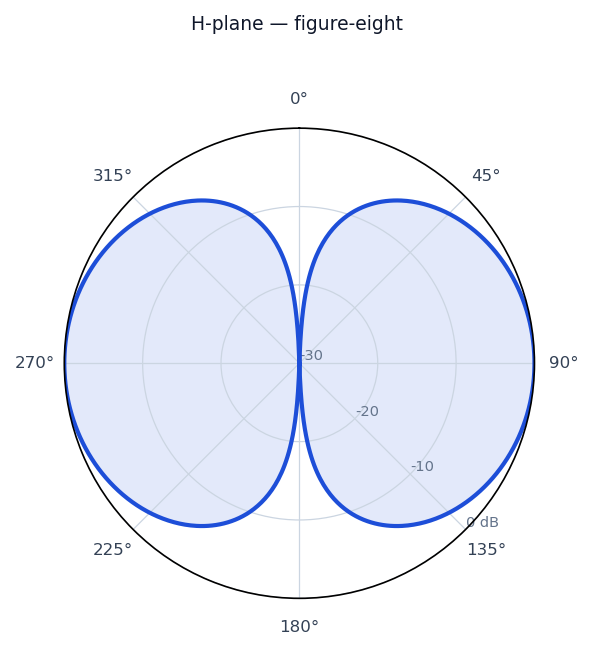
Radiation / wave patterns
New to these diagrams? How to read a radiation pattern →
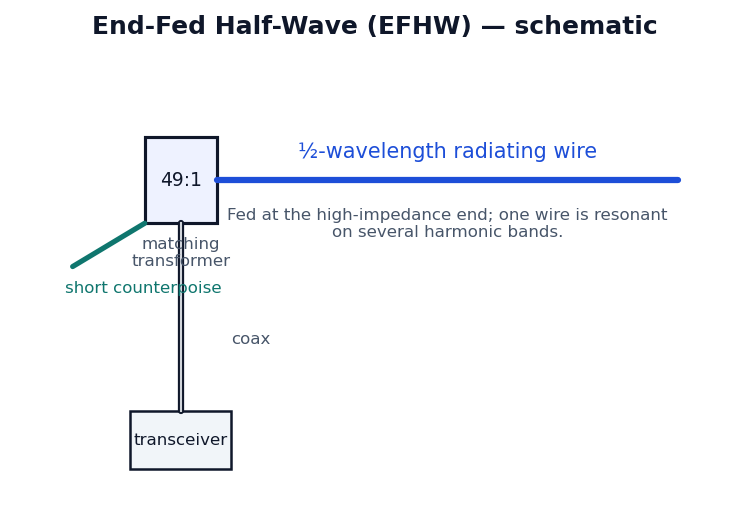
How & why it works
Instead of feeding a half-wave wire at its low-impedance center, the EFHW feeds it at the end, where the impedance is very high (a few thousand ohms). A 49:1 (or 64:1) auto-transformer steps that down to about 50 ohms so coax can be used. Because a half-wave on the lowest band is also resonant on its harmonics, a single wire often works several bands, and end feeding makes it easy to deploy as a sloper or along a fence without a center support.
Real-world uses
Portable and POTA/SOTA operation, stealth home installations, and quick field setups.
Make one at home
A practical starting point — always trim and check SWR for your exact frequency.
See the finished antenna pictured above ↑.
An end-fed half-wave (EFHW) is a single wire fed at the end through a matching transformer — easy to deploy as a sloper.
You’ll need
- A half-wave of wire: 143 ÷ f(MHz) metres for the lowest band
- A 49:1 unun (a toroid transformer — buy one or wind it on an FT-240-43 core)
- A short counterpoise wire (~0.05 λ) on the ground side
Build
- Connect the long wire to the high-impedance side of the 49:1 unun.
- Feed the unun with 50-ohm coax; add a common-mode choke a little way down the coax.
- Attach the short counterpoise to the ground terminal.
Tune
A half-wave on the lowest band is also resonant on its harmonics, so one wire often works several bands. Trim the wire end for lowest SWR.
Safety
- Keep antennas well clear of power lines — never put one where it could fall onto or contact mains wiring.
- Don’t transmit while anyone is close to the antenna; mind RF-exposure limits and your local licensing rules.
- Ground masts and use coax surge protection where appropriate.
- Cutting/soldering: eye protection and a ventilated space.