Full-Wave Loop
Loop Antennas HF Receive 🔧 Buildable at home
A loop one wavelength in circumference with gain and low noise.
- Band
- HF
- Gain
- ~3-4 dBi
- Polarization
- Horizontal or vertical (feed dependent)
Photos
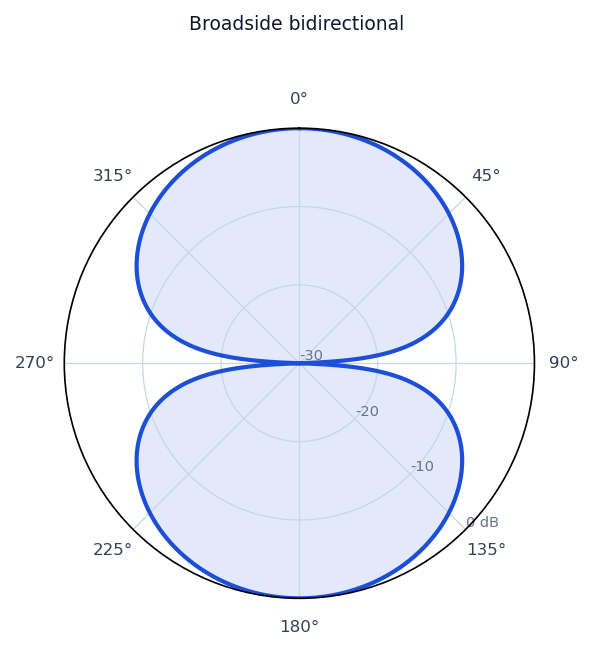
Radiation / wave patterns
New to these diagrams? How to read a radiation pattern →
How & why it works
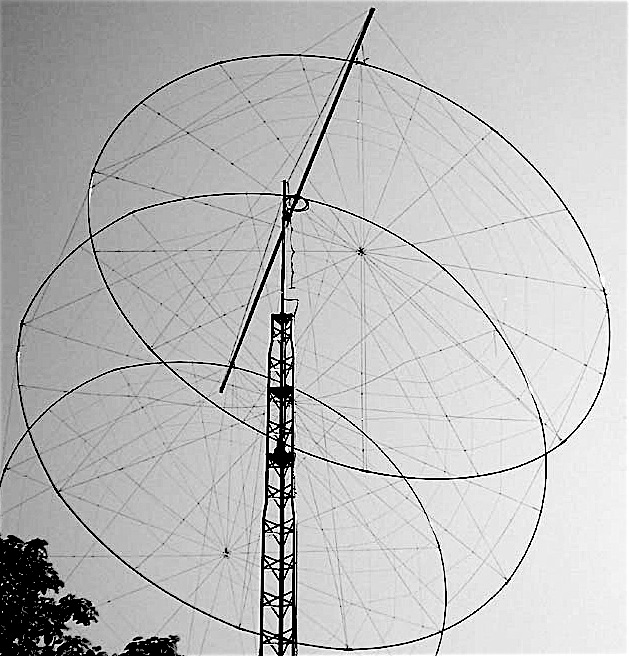
A full-wave loop—square, triangular (delta), or round—has a circumference of about one wavelength, so a full standing wave fits around it. This makes it a resonant, relatively low-impedance antenna (around 100-130 ohms) with a couple of dB more gain than a dipole and a slightly higher radiation angle that favours nearer contacts. Being a closed loop, it tends to pick up less local electrical noise, which receivers appreciate on the low bands.
Real-world uses
Low-noise HF receiving and transmitting, NVIS regional work, and quiet home stations.
Make one at home
A practical starting point — always trim and check SWR for your exact frequency.
See the finished antenna pictured above ↑.
A full-wave (delta) loop is a quiet, slightly-higher-gain alternative to a dipole — a triangle of wire fed at a corner.
You’ll need
- Wire ≈ 306 ÷ f(MHz) metres (one wavelength) for the loop
- Three supports (or one apex support for a delta), insulators
- 50-ohm coax + 1:1 choke (feed impedance is ~100–120 Ω; a 1:1 is a usable compromise, or use a 2:1/4:1 for a better match)
Build
- Form the wire into a triangle (delta) with the apex up.
- Feed at a bottom corner for horizontal polarization (or a side corner for vertical).
- Support the corners with rope and insulators.
Tune
Trim the loop length for lowest SWR. Loops are quiet on receive — good for the low bands.
Safety
- Keep antennas well clear of power lines — never put one where it could fall onto or contact mains wiring.
- Don’t transmit while anyone is close to the antenna; mind RF-exposure limits and your local licensing rules.
- Ground masts and use coax surge protection where appropriate.
- Cutting/soldering: eye protection and a ventilated space.