Inverted-V Dipole
Wire Antennas Beginner HF 🔧 Buildable at home
A center-fed dipole with its ends sloping down from a single high support.
- Band
- HF (160-10 m typically)
- Gain
- ~1.5-2 dBi
- Polarization
- Mostly horizontal (some vertical component)
Photos
Radiation / wave patterns
New to these diagrams? How to read a radiation pattern →
How & why it works
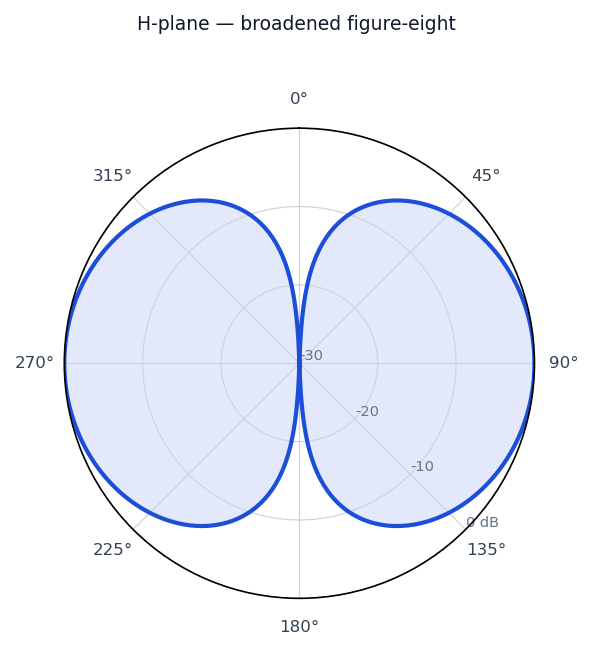
An inverted-V is an ordinary half-wave dipole supported only at the center, with the two legs angled downward (typically 90-120 degrees between them). Needing just one tall support makes it popular for portable and home stations. The drooping legs lower the feedpoint impedance to roughly 50 ohms and broaden the azimuth pattern toward omnidirectional, at the cost of a little gain compared with a flat-top dipole.
Real-world uses
Field Day, portable HF operation, and home stations with a single mast or tree.
Make one at home
A practical starting point — always trim and check SWR for your exact frequency.
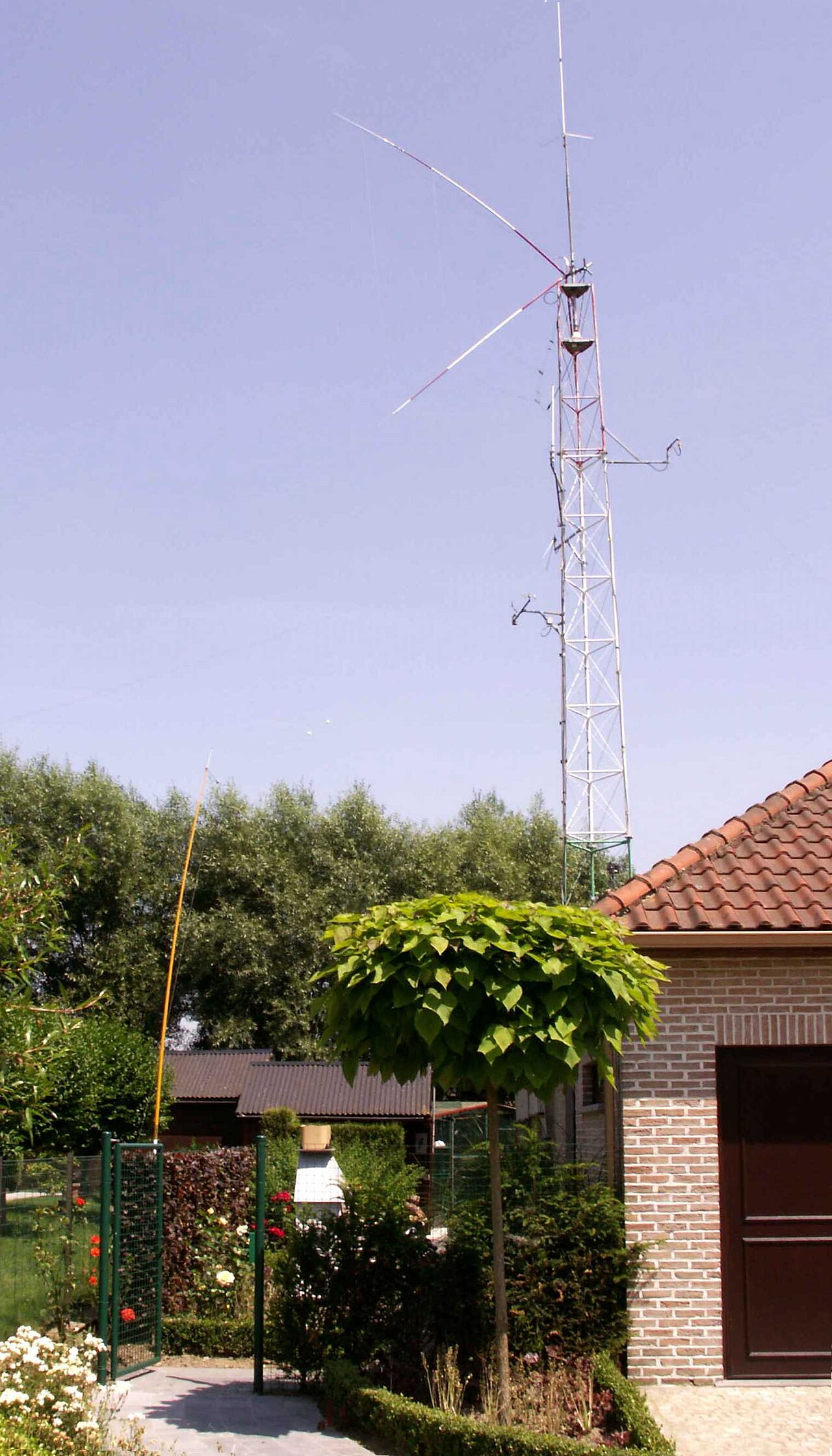
See the finished antenna pictured above ↑.
An inverted-V is a dipole that needs only one central support — great when you have a single tall mast or tree.
You’ll need
- The same parts as a dipole (wire, centre + end insulators, coax, 1:1 choke)
- One central support; two low anchor points for the ends
Build
- Cut a dipole (legs ≈ 71.5 ÷ f(MHz) metres each), feed at the centre.
- Hoist the centre to the top of the mast and let the legs slope down at roughly 90–120° between them.
- Anchor the ends about 2–3 m off the ground (keep them away from people — the wire ends carry high RF voltage).
Tune
The sloping legs lower the feed impedance toward 50 Ω. Trim both ends equally for lowest SWR. Changing the leg angle shifts tuning slightly.
Safety
- Keep antennas well clear of power lines — never put one where it could fall onto or contact mains wiring.
- Don’t transmit while anyone is close to the antenna; mind RF-exposure limits and your local licensing rules.
- Ground masts and use coax surge protection where appropriate.
- Cutting/soldering: eye protection and a ventilated space.