Log-Periodic Dipole Array (LPDA)
Directional Antennas UHF Wideband Directional
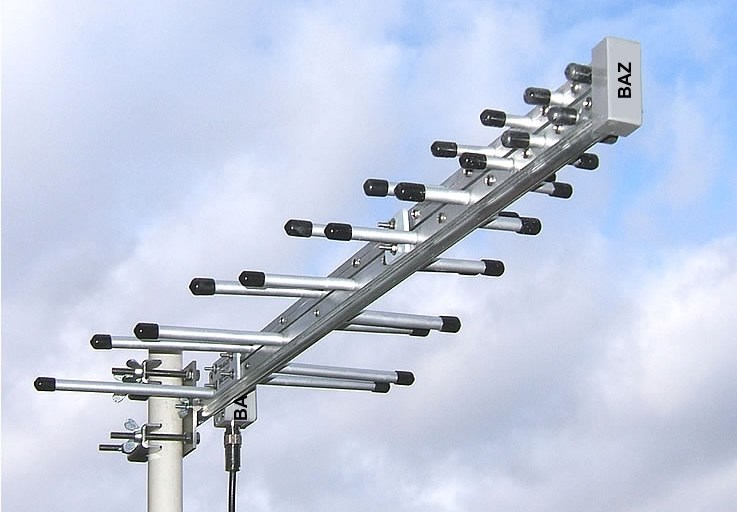
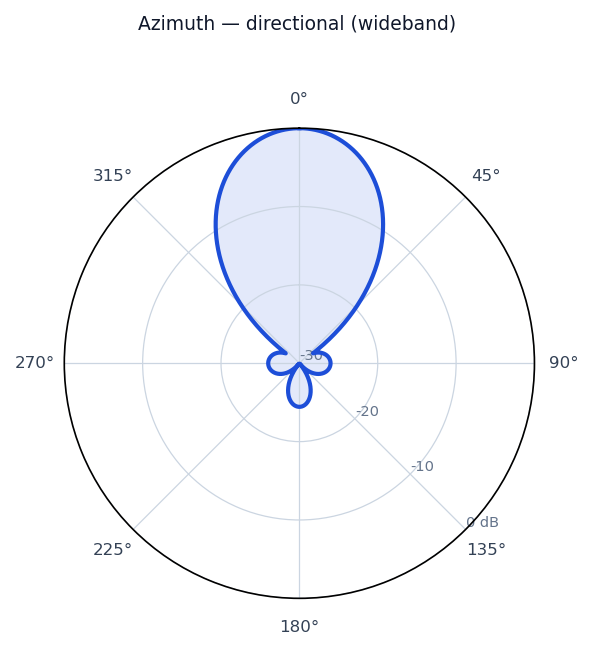
A directional, extremely broadband array of progressively scaled dipoles.
- Band
- HF to UHF (wideband)
- Gain
- ~6-9 dBi
- Polarization
- Linear (element orientation)
Photos
Radiation / wave patterns
New to these diagrams? How to read a radiation pattern →
How & why it works
An LPDA is a row of dipoles whose lengths and spacings scale by a constant ratio, fed by a crisscrossed (phase-reversing) transmission line along the boom. At any frequency in its range only the dipoles near a half-wavelength form an 'active region' and radiate, while the rest are effectively idle; as frequency changes that active region simply slides along the array. This gives directional gain that stays nearly constant across a very wide bandwidth—often more than 10:1—unlike a Yagi, which is sharply tuned.
Real-world uses
TV reception, EMC/antenna test ranges, signal intelligence, and wideband monitoring.