Yagi-Uda
Directional Antennas HF 🔧 Buildable at home
A directional array of a driven dipole with parasitic reflector and directors.
- Band
- VHF/UHF (also HF beams)
- Gain
- ~7-15 dBi (depends on element count)
- Polarization
- Linear (matches the driven element)
Photos
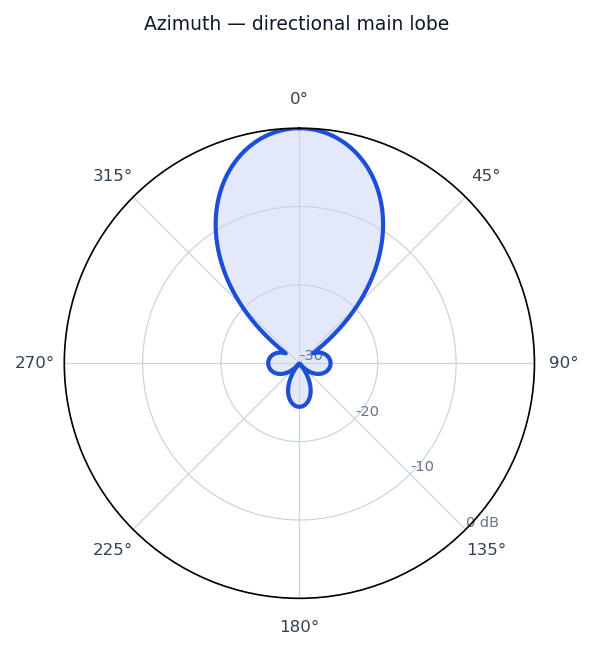
Radiation / wave patterns
New to these diagrams? How to read a radiation pattern →
How & why it works
A Yagi-Uda adds parasitic elements around a driven dipole. A slightly longer reflector behind the driven element and one or more shorter directors in front reshape the radiation pattern by re-radiating the signal with phase shifts that reinforce energy in one direction and cancel it in others. Adding directors narrows the beam and increases forward gain.
Real-world uses
Rooftop TV reception, point-to-point amateur and commercial links, and direction finding.
Make one at home
A practical starting point — always trim and check SWR for your exact frequency.
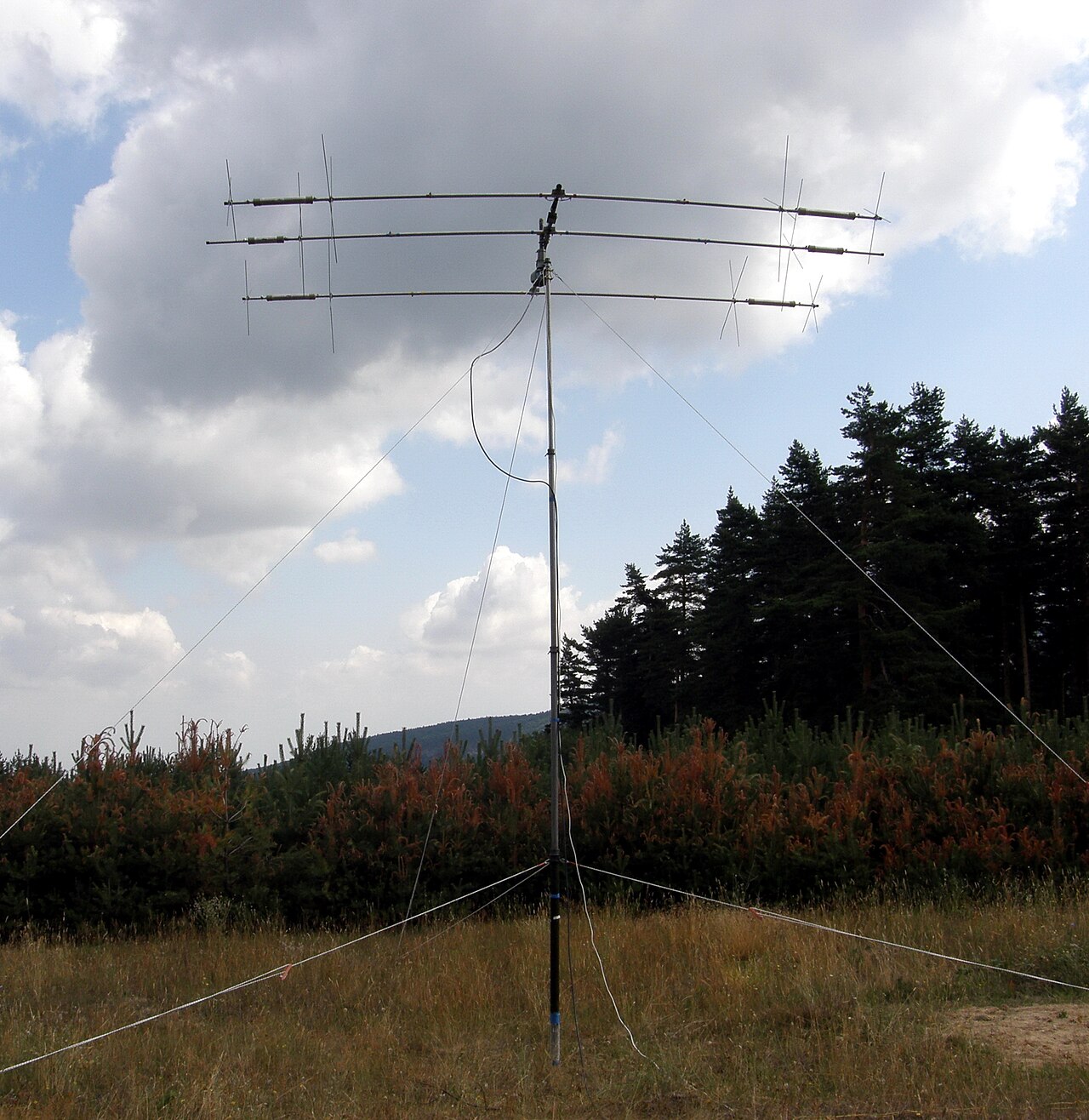
See the finished antenna pictured above ↑.
A Yagi is a rewarding step up — a driven element plus a reflector and directors on a boom. A 3-element 2 m Yagi is a good first beam.
You’ll need
- Aluminium tubing/rod for elements; a wooden or non-conductive boom (or insulate metal-boom elements)
- A driven element with a matching method (gamma match or folded driven element)
Dimensions (3-element, ~146 MHz)
- Reflector: ~101 cm
- Driven element: ~96 cm
- Director: ~92 cm
- Reflector–driven spacing ~35 cm; driven–director ~35 cm. (Use an online Yagi calculator to refine for your exact frequency and tubing diameter.)
Build & tune
- Mount elements on the boom; only the driven element connects to the feed.
- Adjust the gamma match (or driven length) for lowest SWR.
- Point the director end at the station you want to work.
Safety
- Keep antennas well clear of power lines — never put one where it could fall onto or contact mains wiring.
- Don’t transmit while anyone is close to the antenna; mind RF-exposure limits and your local licensing rules.
- Ground masts and use coax surge protection where appropriate.
- Cutting/soldering: eye protection and a ventilated space.